The Future of 6G: When Is It Coming and What to Expect?
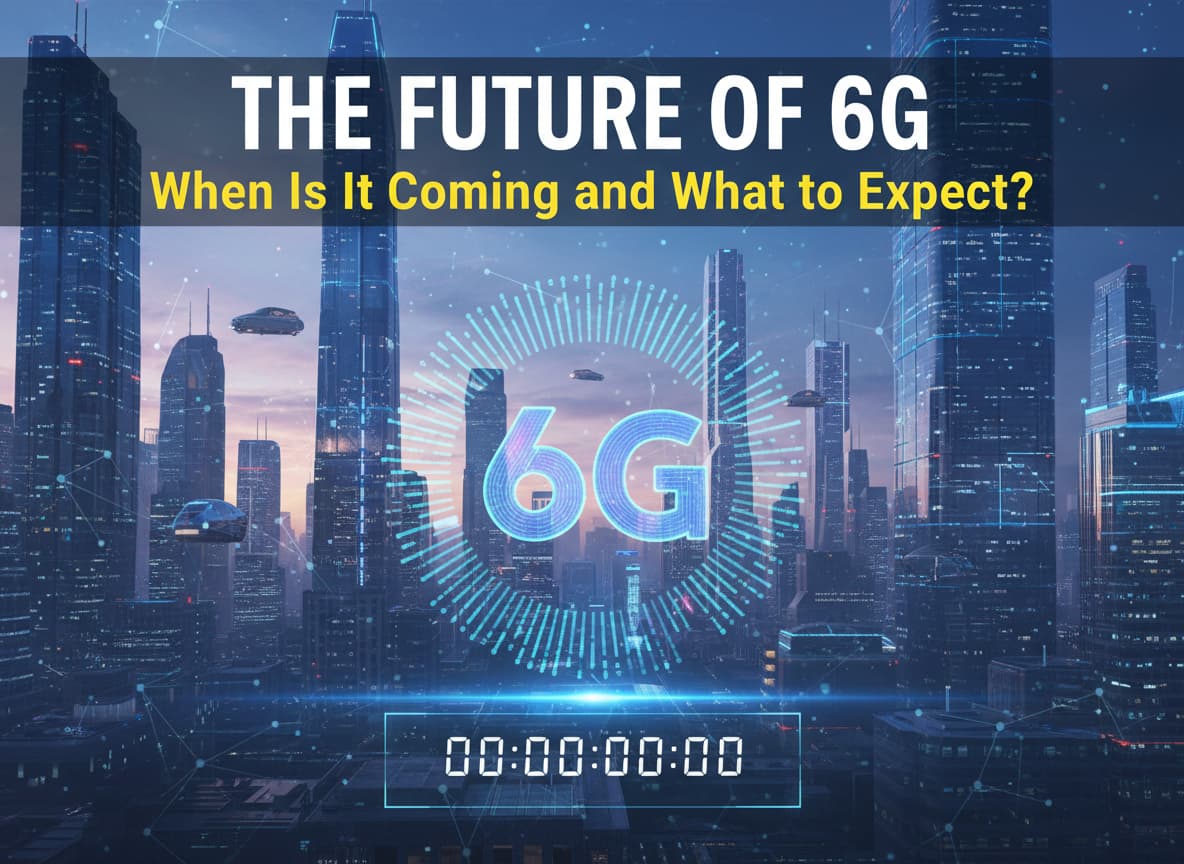
It is late 2025. Your phone likely has a “5G” symbol in the corner right now. You might even have a fast home internet connection. But technology never stops moving. Scientists and engineers are already working hard on the next big thing: 6G.
You might be asking, “Do we really need another ‘G’? Isn’t 5G fast enough?”
The answer is yes, we do need it. 6G is not just about faster downloads. It is about changing how the physical world and the digital world work together. It will turn science fiction ideas—like holograms and smart robot cities—into reality.
In this article, we will explore everything you need to know about 6G. We will look at when it arrives, how fast it really is, and the amazing things it will let us do.
When Will 6G Actually Arrive?
The short answer: Not for a few more years.
Right now, in late 2025, we are in the “Research Phase.” This means scientists are testing the technology in labs, but you cannot buy a 6G phone yet.
Here is the expected timeline based on the latest reports:
- 2025-2027: Engineers agree on the official rules (standards) for how 6G works.
- 2028-2029: The first real tests begin in major cities.
- 2030: The first commercial 6G networks launch in tech-forward countries like South Korea, China, and the USA.
- 2032-2035: Most normal people will start using 6G on their phones.
So, while we are talking about it today, you probably won’t see that “6G” icon on your screen until the early 2030s.
How Fast Is It? (Simple Explanation)
To understand 6G, let’s compare it to what we have used before.
- 4G allowed us to stream video and use apps like Uber.
- 5G allowed us to connect many devices and get faster home internet.
- 6G will be like a fiber-optic cable connected directly to the air.
The Speed Difference 5G can reach speeds of about 10 Gigabits per second (in theory). 6G aims to reach 1 Terabit per second. That is 100 times faster than 5G.
Imagine downloading 100 movies in one second. That is the kind of speed we are talking about. But speed isn’t the most important part. The real magic is “Latency.”
Zero Delay (Latency) Latency is the tiny delay between when you click a button and when the action happens. On 5G, the delay is small (about 4 milliseconds). On 6G, the delay will be less than 1 millisecond—basically instant.
This means a surgeon in New York could control a robot arm in Tokyo to perform heart surgery, and the robot would move at the exact same moment the surgeon’s hand moves.
What Cool Things Will 6G Let Us Do?
Faster internet is boring if it doesn’t change our lives. Here are the three biggest changes 6G will bring.
1. Holographic Communication
We are all used to Zoom calls and FaceTime. But 6G is fast enough to transmit holograms.
Imagine wearing a pair of lightweight glasses and seeing your friend sitting on your couch as a 3D hologram, even though they are in another country. You could walk around them and see them from all angles. This requires sending massive amounts of data instantly, which only 6G can handle.
2. “Digital Twins”
This sounds like a movie concept, but it is very useful for businesses. A “Digital Twin” is a perfect virtual copy of a real thing.
With 6G, a city could have a digital twin. Every car, traffic light, and building would be connected. If a fire truck needs to get through traffic, the city’s computer “brain” would instantly turn all the lights green for the truck because it sees the whole city at once.
Factories are already testing this. They build a digital copy of a machine to test repairs virtually before touching the real, expensive equipment.
3. Truly Autonomous Vehicles
Self-driving cars exist today, but they mostly rely on their own cameras. With 6G, cars will “talk” to everything around them.
Your car will know that a bicycle is coming around the corner before you can see it because the bicycle’s sensor told your car. This “Vehicle-to-Everything” communication needs the super-fast, zero-delay connection of 6G to prevent accidents.
How Does It Work? (The Science Part)
You don’t need a physics degree to understand this. Wireless signals travel on “waves,” just like radio stations.
- 4G used low-frequency waves (travel far, but carry less data).
- 5G uses medium and high waves (faster, but don’t travel as far).
- 6G will use Terahertz (THz) waves.
These are extremely high-frequency waves. They can carry a massive amount of data, but they have a weakness: they are very short-range. They can be blocked by rain, trees, or even a piece of paper.
To fix this, 6G won’t just use big cell towers. It will likely use thousands of tiny antennas hidden in streetlights, walls, and furniture to bounce the signal around obstacles.
Who Is Winning the Race?
Since 6G is so powerful, every major country wants to be the leader.
- China: They are currently leading in patents (owning the ideas). They have already launched a satellite to test 6G signals in space.
- South Korea: Home to Samsung and LG, they are investing heavily to be the first country to launch a 6G network, aiming for 2028.
- USA: The government has formed the “Next G Alliance” with companies like Apple, Google, and AT&T to make sure they don’t fall behind.
- Europe: Companies like Nokia and Ericsson are leading huge research projects to define the rules of 6G.
The Risks and Challenges
It is not all good news. Building 6G is going to be very, very hard.
1. Energy Consumption Sending that much data takes a lot of electricity. Engineers are worried that 6G networks could use too much power, which is bad for the environment. They are trying to invent “green” 6G that turns itself off when no one is using it.
2. Privacy Concerns If 6G allows cameras and sensors to track everything for “Digital Twins,” who owns that data? We will need strict new laws to make sure our private movements aren’t being watched by governments or corporations.
3. The Cost To make 6G work, we need to replace almost all existing cell towers and install millions of new ones. This will cost billions of dollars. Your phone bill might go up to pay for it.
Conclusion
6G is coming, but you don’t need to worry about upgrading your phone yet. For now, in 2025, 5G is still getting better and faster.
However, the future that 6G promises is exciting. It is a world where distance doesn’t matter. A world where you can visit a friend as a hologram, where cars never crash, and where the internet is as invisible and reliable as the air we breathe.
It will arrive around 2030. Until then, we can watch as the researchers turn this sci-fi dream into reality.













Post Comment