Is AI Replacing Programmers? The Truth About Coding with AI
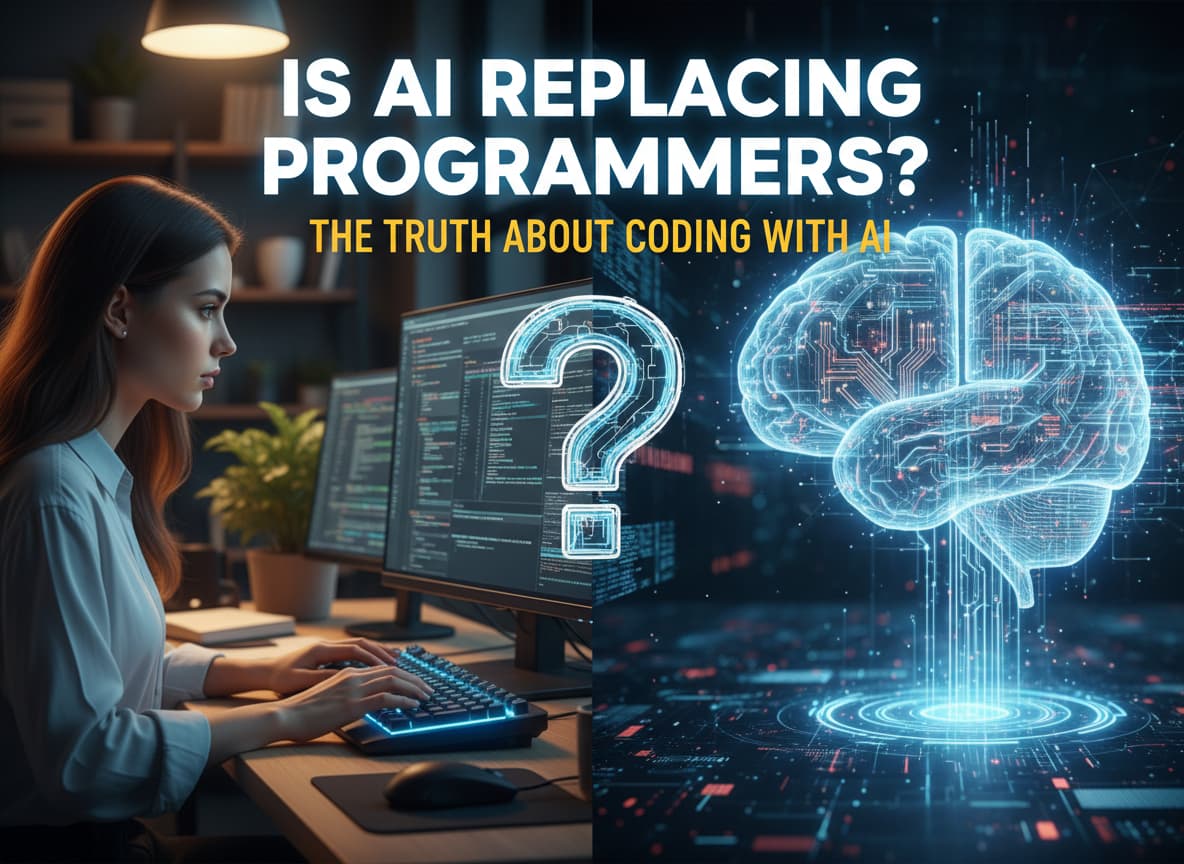
If you are learning to code, or if you already work as a software developer, you might feel worried. You might wonder if your job is safe. You might wonder if you should stop learning to code.
This article will tell you the truth. We will look at what AI can do, what it cannot do, and what the future looks like for human programmers. The short answer is: AI is changing the job, but it is not exactly killing it. Let’s explore why.
The Rise of the “Smart” Coding Assistants
First, we need to understand what is happening right now. In the past, if a programmer wanted to write a function (a small piece of code), they had to type it out line by line. If they forgot how to do something, they had to go to Google, search for an answer, and read documentation.
Now, things are different.
How AI Tools Work
AI tools for coding are like very smart helpers. They have read billions of lines of code from the internet. When you ask them a question, they predict the best answer based on what they have learned.
- Auto-Completion: It is like the auto-correct on your phone, but for computer code. It can finish your sentences or even write whole paragraphs of code for you.
- Bug Fixing: If your code has a mistake (a bug), you can paste it into an AI tool, and it will often tell you what is wrong and how to fix it.
- Translation: AI can turn Python code into JavaScript code instantly.
Because these tools are so fast, companies are very excited. They think, “Maybe we don’t need as many humans if the computer does the work.” This is where the fear comes from.
Why AI is Not a “Senior Developer” Yet
To understand why humans are still needed, we have to look at the difference between “coding” and “programming.”
Coding is the act of writing the language the computer understands. It is like typing words in French or Spanish. AI is very good at this. It knows the vocabulary and the grammar perfectly.
Programming (or Software Engineering) is different. It is about solving problems. It is about building a house, not just laying bricks.
Here are the main reasons why AI is not ready to replace a human software engineer:
1. AI Lacks “Context”
AI does not know why you are building a website. It does not know your customers. It does not know that your boss changed the plan five minutes ago.
For example, you can ask AI to “build a login page.” It will give you the code for a login page. But a human programmer knows that this login page needs to connect to a specific database, it needs to be secure for banking data, and it needs to match the company’s color scheme. AI only sees the small picture; humans see the big picture.
2. AI Makes Mistakes (Hallucinations)
This is a very big problem. AI tools sometimes lie. In the tech world, we call this “hallucinating.”
An AI might write code that looks perfect. It runs without errors. But it might solve the wrong problem, or it might use a library that does not exist. If you do not know how to code, you will not know the AI made a mistake. You need a human expert to check the work. If you just copy and paste AI code without checking it, you could break your entire software system.
3. Security and Privacy
When you work for a big company, you are often dealing with private data. You cannot just paste your company’s secret code into a public AI chatbot. That could be a data leak.
Human programmers understand security rules. They know what information is safe to share and what must be kept secret. AI does not have a conscience or an understanding of legal rules unless it is programmed to, and even then, it can be tricked.
The Shift: From “Writer” to “Editor”
So, if AI is not replacing us, what is it doing? It is changing how we work.
In the past, a programmer spent 80% of their time typing code and 20% of their time thinking. In the future, a programmer will spend 20% of their time typing and 80% of their time thinking, reviewing, and planning.
The New Workflow
Imagine you are a writer. Before, you had to write every word with a pen. Now, you have a typewriter that types fast. You are still the writer, but the tool is better.
With AI, programmers are becoming Editors.
- The programmer plans the software structure.
- The programmer asks the AI to write the boring, repetitive parts.
- The programmer reviews the code to make sure it is safe and correct.
- The programmer connects the pieces together.
This means programmers can work much faster. A project that used to take one month might now take one week.
The Danger for Junior Developers
We must be honest about one specific group: Junior Developers. These are people who are just starting their careers.
Usually, companies hire junior developers to do the simple tasks. They fix small bugs, write simple tests, and update documentation. These are exactly the tasks that AI is very good at.
- The Risk: Companies might hire fewer juniors because AI can do the basic work for free.
- The Solution: Junior developers need to learn faster. You cannot just learn how to write syntax (the words of the code). You must learn how to build systems.
If you are a student right now, do not just memorize code. Learn how to design software. Learn how to find mistakes in AI code. If you can use AI to work faster than other people, you will still get hired.
New Skills You Need to Survive
If you want to stay safe in your career, you cannot ignore AI. You must make it your friend. Here are the skills that will make you valuable in 2025 and beyond.
1. Prompt Engineering
This is a fancy term for “knowing how to talk to the AI.” Some people ask ChatGPT a vague question and get a bad answer. Good programmers know how to ask precise, detailed questions to get the perfect code snippet. Learning how to control the AI is a new programming skill.
2. Debugging
Since AI generates code fast, there will be more code to check. You need to be very good at spotting errors. You need to be a detective. If the AI writes 100 lines of code and there is one hidden error, you must find it.
3. System Design (Architecture)
AI is bad at planning huge projects. It gets confused if the project is too big. Humans need to be the Architects. You need to decide which database to use, how the server talks to the website, and how to make the app fast. This requires critical thinking, which AI does not have.
4. Soft Skills
This is surprising, but true. As AI does the technical typing, your ability to talk to humans becomes more important. You need to talk to clients, understand their needs, and explain technical things to non-technical bosses. AI cannot sit in a meeting and negotiate a project deadline.
The “Calculator” Analogy
Think about mathematics. When the electronic calculator was invented, math teachers were worried. They thought, “Students will forget how to do math!”
Did mathematicians disappear? No. Did accountants disappear? No.
Actually, they became more powerful. Because they didn’t have to do long division on paper, they could solve much harder, more complex problems.
The same thing is happening to coding. AI is the calculator for programming. It removes the boring math so we can solve the hard problems. We are not going to stop coding; we are just going to code better things. We will build smarter apps, faster websites, and more complex games because the “easy” part is automated.
Will Salaries Go Down?
This is a complicated question.
- Scenario A: If AI makes programming very easy, then anyone can do it. If anyone can do it, companies might pay less.
- Scenario B: AI makes programmers super-productive. One programmer can do the work of ten people. This makes that one programmer extremely valuable, and their salary goes up.
Most experts believe Scenario B is more likely for skilled workers. Highly skilled engineers who use AI will be worth a lot of money. However, “code monkeys” (people who just type code without thinking) will see their value drop.
The Future of Software Development
What will the job look like in five or ten years?
It is likely that we won’t type as much code in text files. We might use visual interfaces or voice commands. We might say, “Computer, build a button that sends an email when clicked,” and the AI will build it.
But who decides where the button goes? Who decides what the email says? Who decides what happens if the email server is broken? The Human.
We might stop calling ourselves “Coders” and start calling ourselves “Product Builders” or “System Architects.” The language of code (Python, Java, C++) might become less important than the logic of solving problems.
Focus on Problem Solving, Not Syntax
If you are learning code today, do not obsess over memorizing every single command. The AI knows the commands. Focus on the logic.
- How does a loop work?
- How does data move through an app?
- What makes a website slow or fast?
These are concepts that never change, even if the AI is doing the typing.
Conclusion: Don’t Panic, Adapt
So, is AI replacing programmers?
No. It is replacing the boring parts of programming.
It is replacing the need to memorize thick textbooks. It is replacing the need to type the same basic code over and over again. But it is not replacing the creativity, the logic, and the human understanding required to build great software.
If you refuse to use AI, you might be replaced by a programmer who does use AI. But if you embrace these new tools, you will become more powerful than ever before.
The best advice is to keep learning. Stay curious. Use AI to help you learn faster, but do not let it do all the thinking for you. The world will always need people who can solve difficult problems, and that is exactly what a programmer does.












Post Comment