Space Tech: How Private Companies Are Racing to Mars
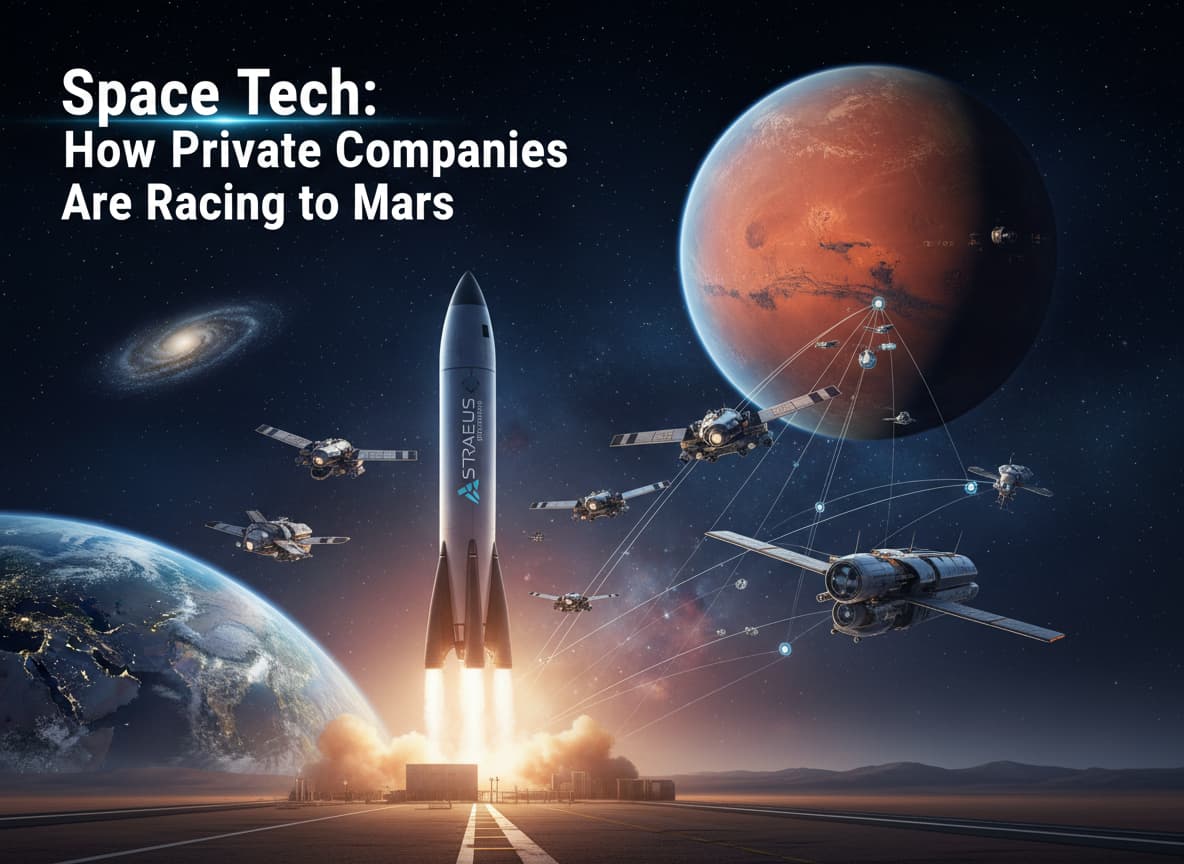
For decades, reaching Mars was a dream reserved for government agencies like NASA. But in late 2025, the story has changed. We are witnessing a new “Space Race,” but this time, the competitors are not countries—they are private companies. Led by billionaires and driven by bold visions, these companies are building the rockets, habitats, and technologies that could make humans an interplanetary species.
The goal isn’t just to visit the Red Planet; it’s to stay there. From SpaceX’s massive Starship to Blue Origin’s reusable rockets, the technology is advancing at a breakneck speed.
In this article, we will explore how private companies are leading the charge to Mars, the incredible technology making it possible, and the massive challenges that still stand in the way.
The Major Players: Who Is Leading the Race?
While many companies are involved in space tech, two giants are currently dominating the headlines in 2025: SpaceX and Blue Origin.
SpaceX: The Starship Revolution
Elon Musk’s SpaceX is undeniably the frontrunner. Their crown jewel is the Starship, a massive, fully reusable rocket designed specifically to carry humans to Mars.
- Current Status (Late 2025): SpaceX is pushing hard for a Mars mission. They plan to launch uncrewed Starships to Mars as early as 2026 to test landing capabilities. If successful, these ships will deliver supplies and equipment before humans arrive.
- The Goal: Musk envisions a self-sustaining city on Mars. The Starship is built to be refueled in orbit, allowing it to carry up to 100 tons of cargo or 100 people on the long journey.
Blue Origin: The New Challenger
Jeff Bezos’s Blue Origin has entered the chat in a big way. In November 2025, they successfully launched their heavy-lift rocket, New Glenn.
- Recent Success: The New Glenn rocket recently carried NASA’s “ESCAPADE” mission—twin probes designed to study Mars’ atmosphere. This was a huge milestone, proving that Blue Origin can send payloads beyond Earth’s orbit.
- The Vision: While SpaceX focuses on colonization, Blue Origin is building the infrastructure for “millions of people living and working in space,” starting with the Moon and expanding outward.
The Tech: How Do You Survive a Trip to Mars?
Getting to Mars is only half the battle. Surviving the 6-to-9 month journey and living on a hostile planet requires revolutionary technology.
1. Reusable Rockets
In the past, rockets were used once and thrown away. That made space travel incredibly expensive. Private companies have perfected reusable rockets. SpaceX’s boosters land themselves back on Earth (or on drone ships in the ocean) after launch. This drastically lowers the cost of sending supplies to Mars.
2. In-Situ Resource Utilization (ISRU)
You cannot bring everything you need from Earth. It is too heavy. The key to Mars colonization is ISRU—using the resources that are already there.
- Fuel from Ice: Mars has ice. Companies are developing technology to mine this ice and convert it into water, oxygen (for breathing), and methane (for rocket fuel).
- Building Materials: 3D printing robots are being designed to build habitats using Martian soil (regolith), protecting astronauts from radiation without needing to ship heavy concrete from Earth.
3. Advanced Life Support Systems
On Mars, there is no air, and the temperature can drop to -80°C (-112°F). Private companies are testing closed-loop life support systems. These systems recycle almost everything—air, sweat, and even urine—into clean water and breathable oxygen. It sounds gross, but it is essential for survival.
The Challenges: Why Is It So Hard?
Despite the excitement, Mars wants to kill you. There are three massive hurdles that private companies must overcome before they can send people.
1. Deadly Radiation
Earth has a magnetic field that protects us from the sun’s harmful radiation. Mars does not.
- The Risk: Astronauts traveling to Mars will be exposed to high levels of cosmic radiation, which can cause cancer and acute sickness.
- The Solution: Engineers are developing new shielding materials and habitats that can be buried underground to block radiation.
2. The Human Factor
Living in a small tin can for months, millions of miles from home, takes a toll on the human mind. Isolation, depression, and anxiety are real risks.
- Mental Health Tech: Future missions will likely use AI assistants (like a super-smart version of Siri or Alexa) to monitor astronauts’ mental health and provide companionship or therapy.
3. The “Seven Minutes of Terror”
Landing on Mars is notoriously difficult. The atmosphere is too thin to slow a heavy spacecraft down effectively, but thick enough to burn it up.
- Precision Landing: SpaceX is relying on the Starship’s unique “belly flop” maneuver to slow down, followed by a propulsive landing (using engines) to touch down gently. This has to work perfectly every single time, or the crew is lost.
The Future: A City on the Red Planet?
So, when will we see boots on Mars?
- 2026: SpaceX plans uncrewed cargo missions to test landings.
- 2030s: The first crewed missions could launch. These astronauts will be the pioneers, setting up the first base.
- 2050s: Elon Musk hopes to have a permanent city with thousands of residents.
It sounds ambitious, and timelines in the space industry often slip. However, the pace of innovation in 2025 is undeniable. We are no longer asking if humans will go to Mars, but when.
Conclusion
The race to Mars is more than just a competition between billionaires. It is driving a technological revolution. The inventions being created for space—from better batteries to advanced water recycling—will eventually help us here on Earth, too.
Private companies have reignited the spark of exploration. As we look up at the night sky in late 2025, the Red Planet feels a little closer than it ever has before.













Post Comment