Tech Predictions: What Will Smartphones Look Like in 2030?
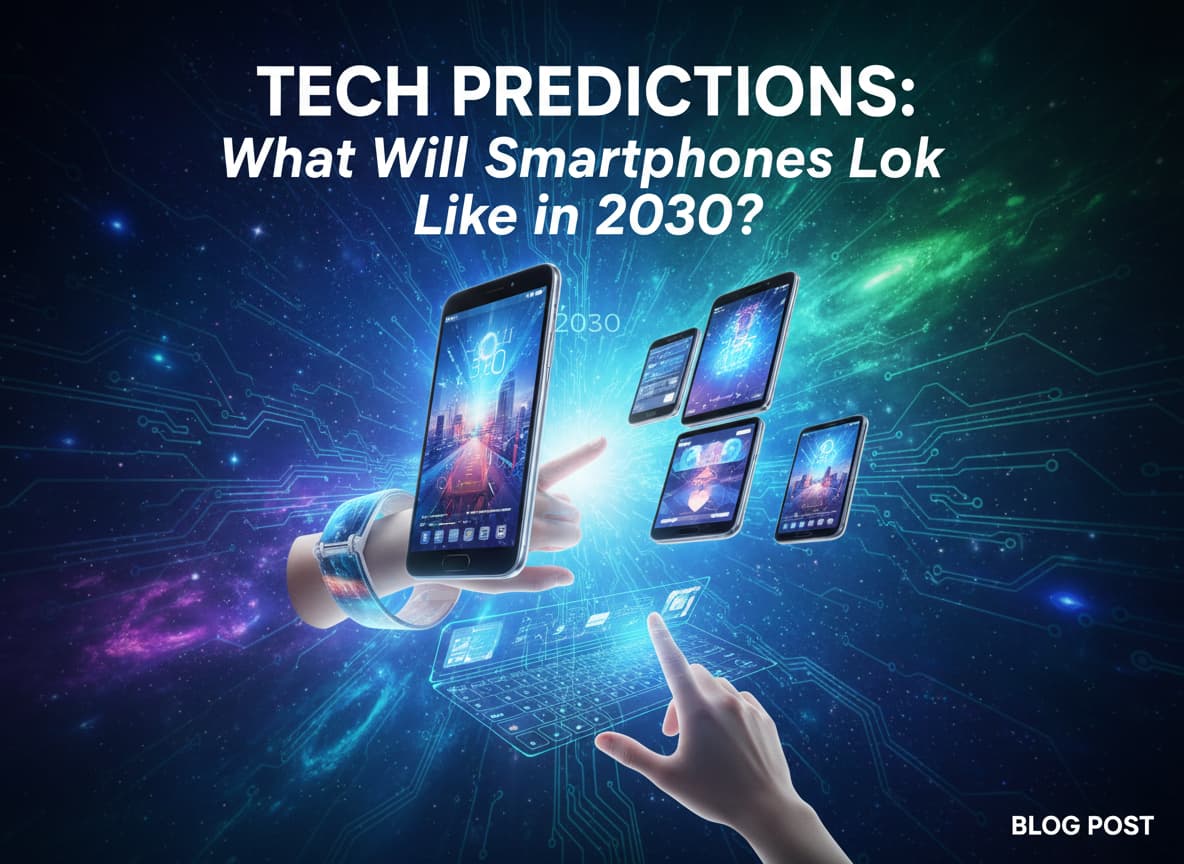
- 1. The Screen Revolution: Folding, Rolling, and Holograms
- 2. Battery Life: No More Daily Charging
- 3. 6G Connectivity: The Internet at the Speed of Thought
- 4. Artificial Intelligence: From Assistant to Partner
- 5. The End of the Handheld? Smart Glasses and Implants
- 6. Sustainability: The Green Smartphone
- Conclusion
Do you remember what your phone looked like ten years ago? It probably had thick borders, a single camera, and a battery that barely lasted a day. Now, look at the device in your hand today. It is a supercomputer with professional cameras and a stunning screen. But technology does not stop. In fact, it is moving faster than ever.
As we look forward to the year 2030, the smartphone is about to go through its biggest change yet. It might not even be a “phone” anymore. It could be a piece of glass, a pair of glasses, or a tiny device that projects a screen onto your hand.
In this article, we will explore the exciting future of mobile technology. We will look at the new screens, batteries that last for weeks, and Artificial Intelligence (AI) that knows what you want before you ask. Here is a glimpse into your pocket in 2030.
1. The Screen Revolution: Folding, Rolling, and Holograms
For the last decade, phones have mostly been black rectangles of glass. That boring design is finally dying. By 2030, your phone will change shape to fit your needs.
Rollable Displays are the New Normal
We have already seen foldable phones that open like a book. The next step is rollable technology. Imagine a phone the size of a lipstick tube. When you need to check a map or watch a movie, you pull the sides, and the screen stretches out like a scroll.
These screens use “organic light-emitting diodes” (OLED) that are printed on plastic instead of glass. This makes them unbreakable. You could drop your phone on the sidewalk, and it would bounce instead of shattering.
The Dream of Holograms
Science fiction movies have promised us holograms for years. By 2030, this could be real. New 6G technology (which we will talk about later) allows for massive amounts of data to travel instantly. This means your phone could project a 3D image of your friend sitting across the table from you during a call. You won’t look at a screen; you will look through it.
2. Battery Life: No More Daily Charging
The biggest complaint everyone has about their phone is the battery. In 2030, charging your phone every night will feel as old-fashioned as winding up a clock.
Solid-State Batteries
Current phones use “lithium-ion” batteries. They are heavy, they get hot, and they lose power over time. The future is Solid-State Batteries.
These new batteries are lighter and safer. They can hold three times as much energy in the same amount of space. Imagine a phone that is as thin as a credit card but lasts for three days on a single charge.
Over-the-Air Charging
Even better, you might never need to plug your phone in at all. Technology companies are developing “True Wireless Charging.”
Right now, “wireless” charging means putting your phone on a special pad. In 2030, chargers will work like Wi-Fi routers. As soon as you walk into your house or a coffee shop, your phone will start charging automatically through the air. You could keep your phone in your pocket, and it would stay at 100% battery all day long.
3. 6G Connectivity: The Internet at the Speed of Thought
You might just be getting used to 5G, but engineers are already building 6G. This isn’t just a small upgrade. It is a completely different beast.
Zero Lag
5G is fast, but 6G is nearly instant. It is predicted to be 50 to 100 times faster than 5G. This speed eliminates “latency” (the delay between clicking a button and something happening).
For gamers, this means playing complex games with zero delay. For doctors, it means performing surgery on a patient in another country using robotic arms controlled over the internet. For you, it means downloading a 2-hour movie in one second.
The “Internet of Everything”
With 6G, everything will be connected. Your phone will talk to your car, your fridge, your city’s traffic lights, and even your clothes. Your phone will act as the “brain” that controls the world around you seamlessly.
4. Artificial Intelligence: From Assistant to Partner
Today, we use AI like Siri or Google Assistant to set timers or check the weather. By 2030, AI will be much smarter. It won’t just wait for your commands; it will predict them.
Proactive Help
Your 2030 smartphone will know your habits perfectly.
- It will notice you are leaving work and automatically order your favorite dinner to arrive when you get home.
- It will sense that you are stressed based on your voice and suggest a relaxing playlist.
- It will translate languages in real-time, not just text but spoken words, whispering the translation into your ear as the other person speaks.
The “App-Less” Future
We currently have hundreds of apps on our phones. In the future, you might not use apps at all. You will just have one “Super AI.” Instead of opening Uber, you will just say, “Get me a car.” The AI will navigate the backend of the internet to find the service for you. The messy grid of icons on your screen will disappear, replaced by a clean, simple interface.
5. The End of the Handheld? Smart Glasses and Implants
This is the most radical prediction. By 2030, the “smartphone” might not be something you hold in your hand. It might be something you wear.
Smart Glasses Take Over
Big tech companies like Apple and Meta are betting billions that Smart Glasses are the future. Imagine wearing a pair of stylish sunglasses. When you get a text message, it floats in the air in front of your eyes. Arrows appear on the sidewalk to show you walking directions.
This is called Augmented Reality (AR). It blends the digital world with the real world. If these glasses become light and cheap enough, we might stop carrying phones in our pockets entirely.
Neural Interfaces
It sounds scary, but some scientists are working on ways to connect computers directly to our brains. While this probably won’t be mainstream by 2030, we might see simple versions like wristbands that can read the electrical signals in your nerves. You could send a text message just by thinking about moving your fingers, without ever touching a screen.
6. Sustainability: The Green Smartphone
Technology creates a lot of waste. Old phones end up in landfills, leaking toxic chemicals. In 2030, the environment will be a top priority for phone makers.
The Circular Economy
Future phones will be made of 100% recycled materials. The aluminum, glass, and plastic will come from old devices.
Modular Design
Instead of buying a whole new phone when your battery dies or your camera gets old, phones will be Modular. This means you can pop out the old battery and slide in a new one, just like changing batteries in a TV remote. You could upgrade just the camera lens without throwing away the screen. This makes phones cheaper to own and much better for the planet.
Conclusion
The smartphone of 2030 will be more than just a gadget. It will be an intelligent companion that helps you navigate life. It will be unbreakable, essentially un-killable with infinite battery, and incredibly fast.
Whether it is a rollable scroll in your pocket or a pair of smart glasses on your face, one thing is certain: the barrier between the digital world and the physical world is disappearing. We are not just using technology; we are living inside it.












Post Comment