The Evolution of Gaming Graphics: What’s Next after Ray Tracing?
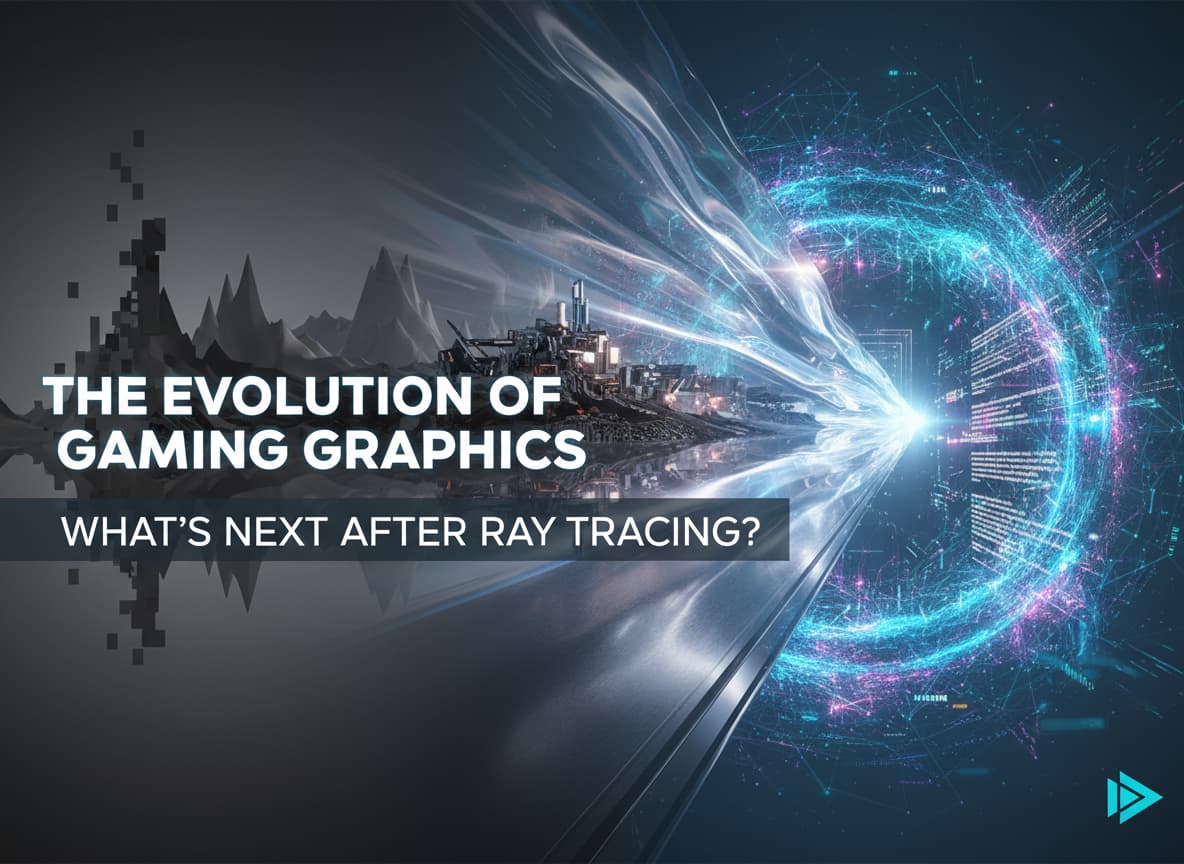
For the last few years, “ray tracing” has been the biggest buzzword in gaming. If you have watched a review for a new graphics card or a PlayStation 5 game, you have heard about it. It promised to make light behave exactly like it does in the real world, creating reflections and shadows that look almost like a photograph.
But technology never stops moving. In 2025, ray tracing is becoming the standard, not just a fancy extra feature. This leaves gamers asking: What comes next?
If ray tracing was about perfecting light, the next era of graphics is about perfecting everything else. We are moving into a world where Artificial Intelligence (AI) doesn’t just help us play games—it helps build them in real-time. Let’s dive into the future of gaming graphics and see what is waiting around the corner.
1. Path Tracing: Ray Tracing’s “Big Brother”
You might think ray tracing is the end of the road for lighting, but it is actually just the beginning. The next step is something called Path Tracing.
Think of ray tracing as a spotlight. It tracks beams of light to see where they hit and bounce. It is very demanding on your computer, so games usually only use it for specific things, like puddles or shadows.
Path tracing, on the other hand, is like turning on the sun. It simulates all the light in a scene at once. It calculates how light bounces off a wall, hits a red carpet, picks up that red color, and then bounces onto a character’s face. This is how movies like Avatar are made, but it used to take hours to render a single frame.
Why it matters: In late 2024 and 2025, we are starting to see “Full Path Tracing” in games. This means no more “fake” lights placed by developers. If you turn on a flashlight in a game, the light will bounce, scatter, and illuminate the room exactly as it would in real life. It is the holy grail of realism.
2. Neural Rendering: Graphics Powered by AI
This is the biggest game-changer. For decades, graphics cards (GPUs) have been doing pure math to draw pixels on your screen. But now, AI is learning to “imagine” graphics instead of just calculating them. This is called Neural Rendering.
How It Works
Traditional rendering is like painting a picture by following strict rules: “Draw a line here, color this red.” Neural rendering is more like asking an artist to “finish this sketch.”
NVIDIA is leading this charge with technology that uses AI to predict what a texture or an object should look like. Instead of your computer working hard to draw every single leaf on a tree, the AI can look at a simple shape and “hallucinate” the details of the leaves, bark, and shadows instantly.
The Result?
- Photorealistic Graphics: AI can generate textures that look like real skin or fabric, far better than traditional 3D modeling.
- Insane Performance: Since the AI is doing the heavy lifting, your graphics card doesn’t have to work as hard. This means games can look better and run faster at the same time. NVIDIA predicts that future GPUs will generate 15 out of every 16 pixels using AI.
3. Generative AI: Infinite Worlds, Created Instantly
We have all seen what tools like ChatGPT and Midjourney can do. Now, imagine that technology inside a video game engine. This is Generative AI for assets.
In the past, if you wanted a forest in a game, an artist had to model the trees, paint the textures, and place them by hand. In the near future, your computer will generate the forest while you are playing.
Why This is Huge
- Never-Ending Content: Imagine a game where you walk into a city, and every building you see was just created uniquely for you. No two players would see the exact same world.
- Dynamic Storytelling: NPCs (non-player characters) won’t just repeat the same three lines. They will have AI brains that can generate new dialogue, facial expressions, and even voices in real-time based on what you do.
Companies like Ubisoft and Unity are already building these tools. They believe this shift is as big as the move from 2D to 3D graphics in the 1990s.
4. Unreal Engine 5.4 and “Nanite”
While AI is the future, we also have incredible engines improving right now. Unreal Engine 5 introduced a technology called Nanite, and in 2025, it is getting even better.
Nanite changes how 3D models are handled. Before, game developers had to create “low-detail” versions of objects so the game wouldn’t crash. If you got close to a rock, you might see it look blocky and blurry.
With Nanite, developers can import movie-quality 3D models with billions of polygons directly into the game. The engine automatically handles the detail.
- No More “Pop-In”: You know when you are driving in a game and a building suddenly appears out of nowhere? Nanite fixes that.
- Infinite Detail: You can look at a pebble on the ground, and it will have as much geometric detail as a mountain.
The latest version, Unreal Engine 5.4, makes this faster and adds “Tessellation,” which allows for even more realistic bumpy surfaces like brick walls or muddy roads without slowing down the game.
5. The Hardware: What Will Power This?
All this software magic needs powerful hardware. We are looking ahead to the NVIDIA RTX 50-Series and AMD Radeon RX 9000 Series, expected to arrive around 2025-2026.
These new cards are not just about “more raw power.” They are being built specifically for the AI technologies we just talked about.
- GDDR7 Memory: This new type of video memory is much faster, allowing games to load massive, detailed textures instantly.
- AI Cores: Future GPUs will devote more space to “Tensor Cores” (the part that handles AI) than ever before. They are shifting from being “calculators” to being “AI brains”.
Conclusion: A New Reality
So, is ray tracing dead? No. It is just becoming the foundation. The future of gaming graphics isn’t just about bouncing light beams anymore. It is about Neural Rendering, Path Tracing, and Generative AI working together to create worlds that don’t just look real—they feel real.
We are moving away from “tricking the eye” with clever art styles and moving toward simulating reality itself. For gamers, the next few years will be an exciting ride into the unknown. Get your eyes ready.













Post Comment