The Future of Work: Hybrid Models and Digital HQs
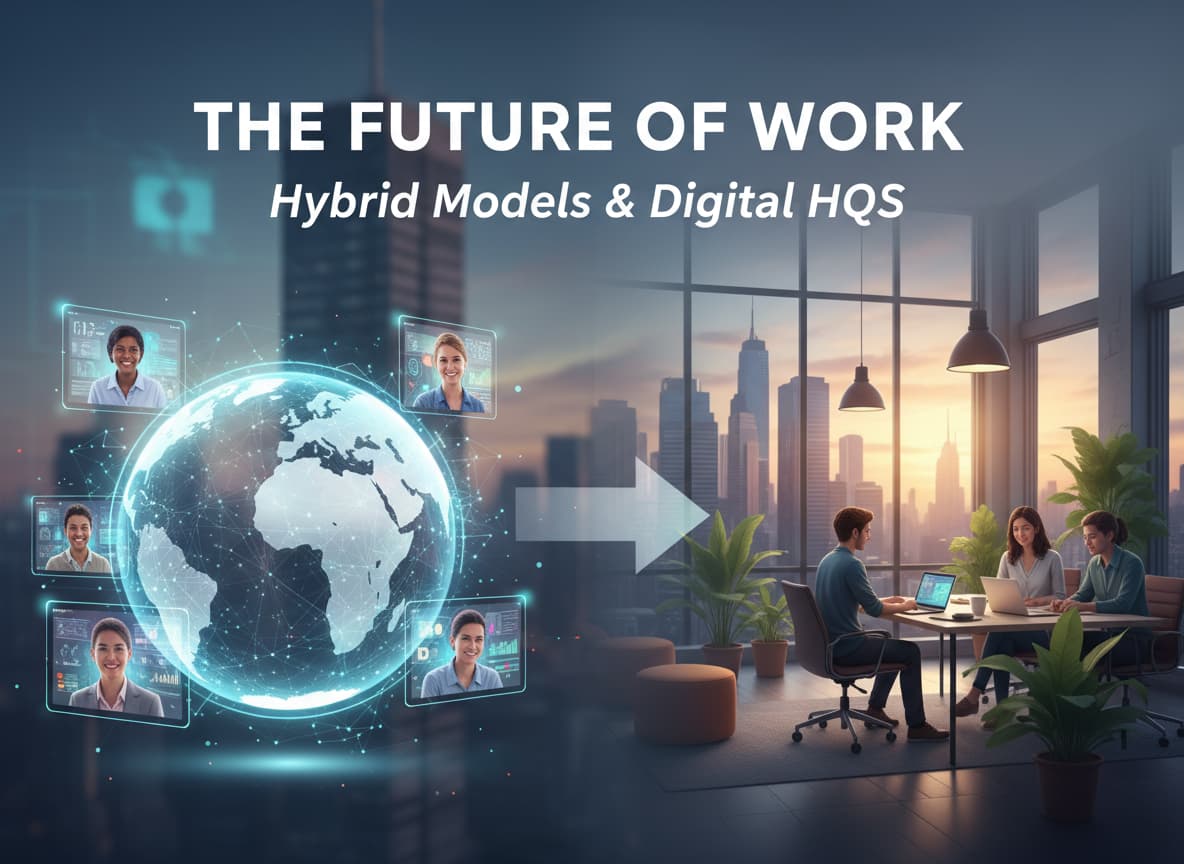
For a long time, “going to work” meant leaving your house, driving to a building, and sitting at a desk from 9 AM to 5 PM. If you weren’t in the building, you weren’t working. But the world has changed.
Today, work is not a place you go. It is something you do.
We are now in the era of Hybrid Work. This is a mix of working from home and working in an office. But this new way of working brings a big question: If we aren’t all in the same building, where is the company’s headquarters?
The answer is the Digital HQ.
In this article, we will explore how work is changing in 2025, what a Digital HQ actually is, and how technology is making it all possible.
The Big Shift: Why We Are Never Going Back
Before 2020, most companies believed that employees had to be watched to be productive. Managers thought that if they couldn’t see you, you probably weren’t working hard.
The global pandemic proved that idea was wrong. Millions of people worked from home, and businesses kept running. In fact, many people were more productive because they didn’t have to spend two hours in traffic every day.
Now, we have settled into a middle ground. We know that working from home is great for focus, but being in the office is great for meeting people and brainstorming ideas.
This is why Hybrid Models are winning. A recent study showed that over 50% of workers who can work remotely now have a hybrid schedule. They might go to the office on Tuesday and Wednesday, but work from home the rest of the week.
What is a “Digital HQ”?
If your team is scattered across different cities, or even just different houses in the same city, you cannot rely on a physical building to hold everything together. You need a central place where work happens.
A Digital HQ (Digital Headquarters) is the software that replaces your physical office. It is the one place where everyone logs in to talk, share files, and make decisions.
In the past, your HQ was a building made of brick and glass. Today, your HQ is built with code.
The Tools That Build Your Digital Office
A Digital HQ is usually made of three types of technology working together:
- The Town Square (Communication): Apps like Slack or Microsoft Teams act like the office lobby or the water cooler. This is where quick chats happen. Instead of walking to someone’s desk, you send them a message.
- The Conference Room (Video): Apps like Zoom or Google Meet are where meetings happen. In 2025, these tools are getting smarter. They can now use AI to take notes for you, so you can focus on talking instead of typing.
- The Filing Cabinet (Knowledge): Tools like Notion, Confluence, or Google Drive are where the company’s brain lives. Since you can’t ask your neighbor “Hey, where is that file?”, everything must be written down and searchable.
Benefits of the Hybrid Model
Why are so many companies choosing this style? It is not just about being nice to employees. It makes business sense.
1. Access to Talent
If you force everyone to come to an office in New York, you can only hire people who live in New York. If you have a Digital HQ, you can hire the best person for the job, whether they live in London, Texas, or Tokyo.
2. Saving Money
Offices are expensive. Renting a big building, paying for electricity, and buying coffee for 500 people costs a lot of money. With a hybrid model, companies can rent smaller offices because not everyone is there at the same time.
3. Happier Employees
Flexibility is the number one thing workers want in 2025. Being able to pick up kids from school or go to a doctor’s appointment without asking for a full day off makes people much happier. Happy employees usually stay at their jobs longer.
The Hidden Dangers: It’s Not All Perfect
While hybrid work sounds amazing, it comes with new challenges that technology leaders need to solve.
The “Proximity Bias”
This is a fancy term for a simple problem: “Out of sight, out of mind.”
Imagine your boss is in the office today. Two of your coworkers are also in the office, having lunch with the boss. You are working from home. Even if you are working harder than them, the boss sees them. They might get the promotion just because they were visible.
Communication Breakdowns
In a Digital HQ, you have to be very clear when you write. In person, you can see if someone looks confused. On a screen, you can’t always tell. This can lead to misunderstandings.
Burnout and “Always On”
When your office is your laptop, it is hard to leave work. In the old days, you left the building and work stopped. Now, you might get a notification at 8 PM while watching TV. It is hard to disconnect, which leads to stress.
Future Tech: What Work Will Look Like in 2030
We are just at the beginning of this change. Technology is moving fast to make the Digital HQ feel just as real as a physical one. Here is what is coming next.
The Metaverse and VR Offices
Video calls can be tiring (we call it “Zoom Fatigue”). To fix this, tech companies are building Virtual Reality (VR) offices.
Imagine putting on a lightweight headset. Suddenly, you are sitting in a virtual room. You can see your coworker’s avatar sitting next to you. You can turn your head and look at a whiteboard. It feels like you are together, even if you are thousands of miles apart. This technology creates a sense of “presence” that a laptop screen cannot give.
AI Assistants as Teammates
Artificial Intelligence (AI) is playing a huge role in the Digital HQ. In the future, every employee will likely have an AI assistant.
- Scheduling: The AI will talk to your coworkers’ AI to find the perfect meeting time.
- Summarizing: Missed a meeting? The AI will send you a 3-sentence summary of what happened.
- Writing: The AI will help draft emails and reports, saving you hours of typing.
How to Succeed in a Digital HQ
If you are a worker in this new world, you need a new set of skills. Being good at your job isn’t enough anymore. You also need to be a Digital Communicator.
- Write Clearly: Since you talk less face-to-face, your writing needs to be excellent.
- Be Visible: Post updates in public channels. Let people know what you are working on so you don’t become invisible.
- Respect Time: Don’t expect instant replies. Your coworker might be in a different time zone or focusing on deep work.
Conclusion
The 9-to-5 office life is fading away. The future of work is flexible, digital, and global.
While there are challenges to overcome, the combination of Hybrid Models and Digital HQs offers a better way to live. It gives us the freedom to work where we are happiest, while using technology to stay connected to our teams.
The office is no longer a destination. It is a network. And as long as you have a good internet connection, you are open for business.







Post Comment