The Impact of 5G on Gaming and Streaming
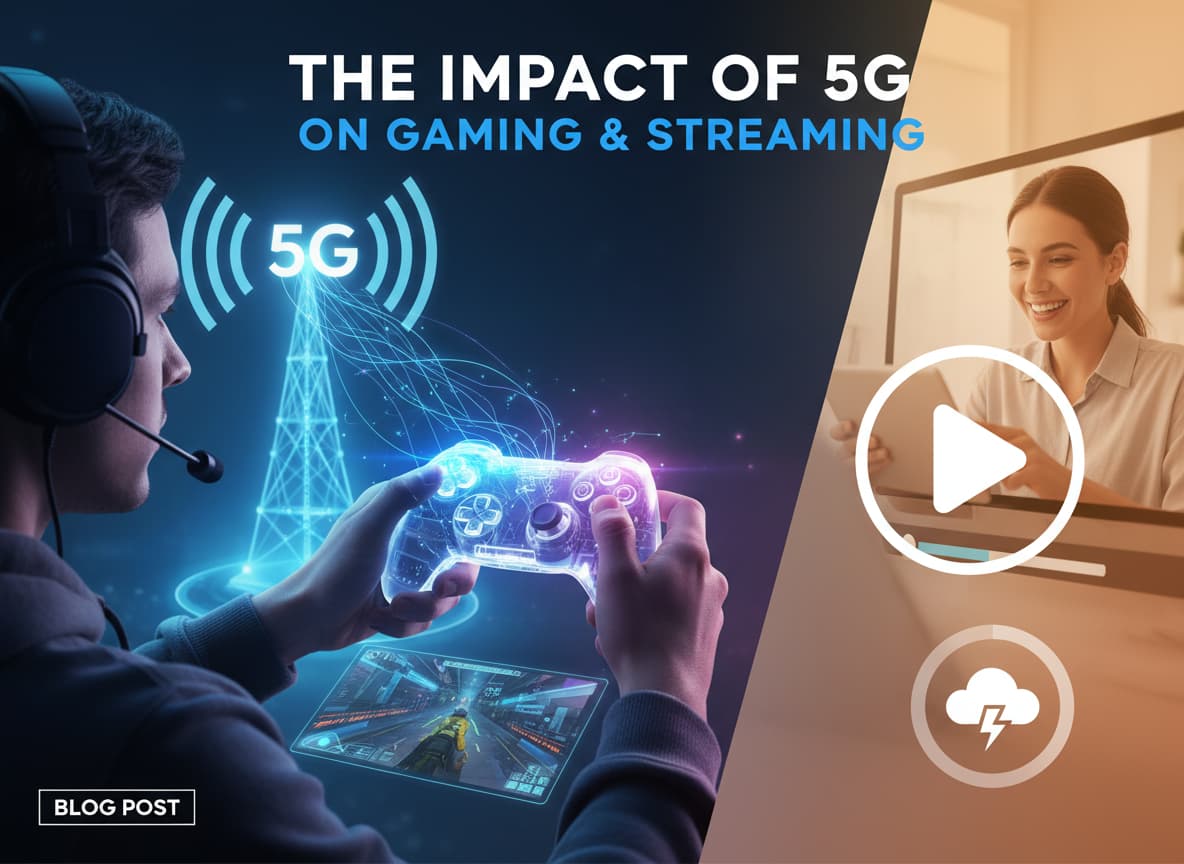
Have you ever been in the middle of an important online game, only for your screen to freeze at the worst possible moment? Or have you tried to watch a movie on the bus, but the “loading” circle just keeps spinning? These annoying problems are usually caused by slow internet.
For years, we have relied on 4G networks. They were good for checking email and browsing the web, but they struggle with big tasks like high-quality gaming and 4K video. Now, a new technology called 5G is changing everything. It is not just a small upgrade; it is a massive leap forward that will change how we play and watch forever.
This article will explain exactly how 5G works and why it is a game-changer for gamers and streamers.
What is 5G and Why is it Special?
Before we look at gaming, let’s understand what 5G actually is. “5G” stands for the “fifth generation” of mobile networks. It is designed to fix the three biggest problems with older internet connections: speed, delay, and capacity.
1. Super Fast Speeds
The most obvious change is speed. 5G can be up to 100 times faster than 4G. While 4G might download a movie in 10 minutes, 5G can do it in just a few seconds. It offers peak data rates of up to 20 Gigabits per second (Gbps). This means you can download huge game files or upload videos almost instantly.
2. Ultra-Low Latency (No More Lag)
Speed is how fast data moves, but “latency” is how fast the network reacts. This is often called “ping.”
- 4G Latency: On older networks, the delay is usually around 30-50 milliseconds (ms). This sounds fast, but in a fast-paced game, it is enough to make you miss a shot.
- 5G Latency: 5G aims to bring this delay down to as low as 1 millisecond. This is “near-instantaneous.” When you press a button, the action happens on the screen immediately.
3. Massive Capacity
Have you ever been to a concert or a sports stadium and lost your signal because too many people were using their phones? 4G networks get clogged easily. 5G is built to handle 1 million devices per square kilometer. This means you get a strong signal even in crowded places.
How 5G is Changing Gaming
Gaming is no longer just about sitting on a couch with a console. 5G is unlocking new ways to play that were impossible before.
The Rise of Cloud Gaming
The biggest change is “Cloud Gaming.” In the past, you needed to buy a specialized console (like a PlayStation or Xbox) or an expensive PC to play the best games. The computer inside the console did all the hard work.
With Cloud Gaming, the game runs on a powerful computer in a data center miles away. The video is streamed to your phone or TV, and your button presses are sent back to the server.
- The 5G Difference: For this to work, you need a super fast connection. If there is any delay, the game feels “mushy” and unplayable. 5G’s low latency makes cloud gaming feel just like playing on a local console.
- No Downloads: You don’t need to wait hours to download a 100GB game. You just click “Play,” and it starts instantly from the cloud.
- Play Anywhere: You can play high-quality “AAA” games on a cheap smartphone or an old laptop, as long as you have a 5G signal.
Mobile Gaming Goes “Pro”
Mobile games used to be simple puzzle games like Candy Crush. Now, developers are making huge, complex games for phones. 5G allows these games to have console-quality graphics and huge open worlds.
- Multiplayer Fairness: In competitive games like Fortnite or Call of Duty Mobile, a slow connection usually means you lose. 5G levels the playing field. With latency under 10ms, mobile players can compete seriously without lag.
- Faster Updates: Modern games have frequent updates that can be huge. With 5G, you can download a 1GB patch in seconds while you wait for the bus.
Augmented Reality (AR) and Virtual Reality (VR)
You might remember Pokémon GO, where you catch digital monsters in the real world. That is “Augmented Reality” (AR). 5G will make AR much better.
- Processing Power: AR requires a lot of computing power to recognize objects in the real world. With 5G, your phone can send that data to the cloud to be processed and sent back instantly. This saves your battery and allows for much smarter AR graphics.
- Wireless VR: Virtual Reality usually requires a heavy cable connecting your headset to a PC. 5G is fast enough to stream VR wirelessly, allowing you to move around freely without tripping over wires.
How 5G is Revolutionizing Video Streaming
We all love watching videos on Netflix, YouTube, and Twitch. 5G solves the biggest headaches of streaming: buffering and low quality.
4K and 8K Streaming on the Go
On 4G, trying to watch a video in 4K quality often leads to the dreaded “buffering” wheel. The network just isn’t fast enough to deliver that much data smoothly.
- Crystal Clear Quality: 5G networks are fast enough to stream 4K and even 8K video to your mobile device without stopping.
- Instant Start: Videos start playing the moment you tap them. The “loading” time is basically eliminated.
- No Traffic Jams: Because 5G has more “lanes” for data, your video won’t slow down just because your neighbors are also watching Netflix at the same time.
Better Live Streaming for Creators
If you are a content creator on TikTok, Twitch, or YouTube, 5G is a powerful tool.
- Go Live From Anywhere: In the past, “IRL” (In Real Life) streamers had to carry heavy backpacks with multiple modems to get a stable signal. Now, a single 5G phone can broadcast high-quality video from a park, a concert, or a crowded street.
- Real-Time Interaction: When you stream on 4G, there is often a delay of 10-20 seconds between you speaking and your viewers hearing it. 5G reduces this delay significantly. You can talk to your chat and answer questions in almost real-time.
- Reliability: 5G networks are more stable. This means fewer dropped streams and glitchy audio, even when you are moving around.
Immersive Video Experiences
5G opens the door for new types of video formats.
- 360-Degree Video: Imagine watching a football game and being able to look around the stadium as if you were sitting in the stands. 5G can handle the massive amount of data needed for 360-degree live streams.
- Multi-Camera Angles: Some sports broadcasts now let you choose your own camera angle on your phone. 5G provides the bandwidth to stream multiple camera feeds at once so you can be the director.
The Secret Tech: Edge Computing and Network Slicing
How does 5G actually achieve all of this? There are two “secret weapons” behind the technology.
1. Edge Computing
Usually, when you connect to a server, your data has to travel hundreds of miles to a big data center and back. This distance causes delay. “Edge Computing” moves the servers closer to you. 5G networks install small computers in local cell towers or nearby buildings. Because the server is physically closer to your house, the data travels a shorter distance, making everything faster. This is critical for reducing the lag in cloud gaming.
2. Network Slicing
Imagine the internet is a highway. On 4G, cars (video), trucks (downloads), and ambulances (emergency services) are all stuck in the same traffic jam. 5G uses “Network Slicing.” It creates separate virtual lanes for different types of traffic.
- Lane 1: High-speed lane for gamers who need low latency.
- Lane 2: High-capacity lane for people streaming 4K movies.
- Lane 3: Reliable lane for smart cars and emergency services. This ensures that a gamer doesn’t get lag just because someone else is downloading a huge file.
When Will We See These Changes?
The good news is that 5G is already here. By 2025, it is projected that 65% of the world’s population will have access to 5G coverage. Major cities across the US, Europe, and Asia already have strong 5G networks.
However, there are still some challenges:
- Device Compatibility: You need a new phone or tablet that supports 5G. Old 4G phones cannot connect to the new network.
- Rural Coverage: While cities have fast speeds, rural areas are still catching up. 5G helps bridge this gap, but it takes time to build towers everywhere.
- Battery Life: Using high-speed 5G for gaming can drain your phone battery faster than 4G, although the technology is becoming more efficient.
Conclusion
5G is not just about faster download speeds. It is a completely new foundation for the internet. For gamers, it means the end of expensive hardware and the death of lag. For streamers, it means cinema-quality video in the palm of your hand.
As more people upgrade to 5G devices and networks continue to grow, we will see even more amazing innovations. From Virtual Reality concerts to multiplayer games played on the cloud, the future of entertainment is faster, clearer, and more immersive than ever before. The buffer wheel is finally becoming a thing of the past.









Post Comment