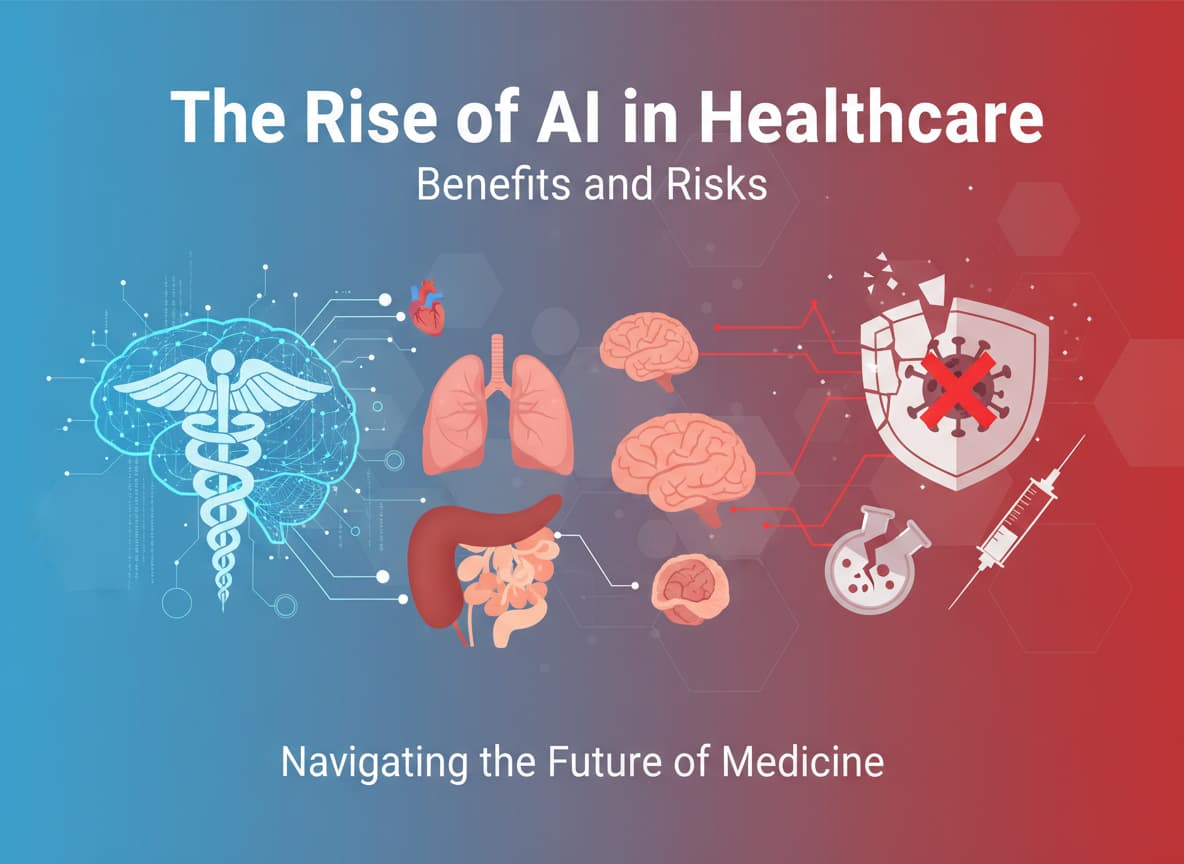
The Rise of AI in Healthcare: Benefits and Risks
- The New Era of "Smart" Medicine
- Benefit 1: Catching Diseases Early
- Benefit 2: Developing Medicines Faster
- Benefit 3: Personalized Treatment for You
- Benefit 4: Helping Doctors Focus on Patients
- Risk 1: Privacy and Data Leaks
- Risk 2: The "Black Box" Mystery
- Risk 3: Bias and Unfairness
- Risk 4: Who is Responsible?
- The Future: Humans and AI Together
- Conclusion
The world of medicine is changing faster than ever before. In late 2025, Artificial Intelligence (AI) is no longer just a cool idea from science fiction movies. It is a real, powerful tool that doctors, nurses, and hospitals use every single day. From finding hidden diseases to helping scientists create new life-saving drugs, AI is reshaping how we take care of our bodies.
However, like any powerful new invention, AI brings both great rewards and serious dangers. It can save lives, but it can also make mistakes or put our private secrets at risk. To understand the future of medicine, we must look at the full picture.
This article will explore the incredible rise of AI in healthcare, the amazing benefits it offers, and the risks we need to watch out for.
The New Era of “Smart” Medicine
For hundreds of years, medicine relied entirely on human memory. A doctor had to memorize thousands of symptoms, diseases, and treatments. If a doctor was tired or missed a small detail, a mistake could happen.
Today, AI acts like a super-smart assistant that never sleeps and never forgets. It can read millions of medical pages in seconds. It can compare a patient’s symptoms with every known disease in the world instantly. This does not mean robots are replacing doctors. Instead, it means doctors now have a powerful partner to help them make better, faster, and safer decisions.
Benefit 1: Catching Diseases Early
One of the most important jobs in medicine is “diagnostics.” This is the fancy word for figuring out what is making a sick person feel bad. AI is becoming a champion at this.
Super-Powered Eyes for Scans Doctors look at thousands of X-rays, CT scans, and MRIs every year. It can be exhausting. AI tools are now being used as a “second pair of eyes.” In 2025, studies have shown that smart computer programs can spot signs of cancer, strokes, or eye diseases with incredible accuracy.
For example, a new AI software can look at a brain scan and identify a stroke twice as fast as human professionals. This speed is critical because, in a stroke, every second counts. The faster the doctors know, the more brain cells they can save.
Predicting the Future Imagine if a doctor could tell you that you are going to get sick before you even feel pain. AI is making this possible through something called “predictive analytics.”
Hospitals like the famous Cleveland Clinic are using AI systems to watch patients closely. The computer analyzes simple things like heart rate and blood pressure to predict if a patient is at risk of a cardiac arrest (heart attack). By spotting these tiny warning signs, doctors can step in and stop the heart attack before it happens. This shifts medicine from just “fixing” problems to actually “preventing” them.
Benefit 2: Developing Medicines Faster
Creating a new medicine is a very long and hard process. In the past, it could take more than 10 years and cost billions of dollars to bring just one new drug to the pharmacy. AI is speeding this up in a huge way.
Designing New Molecules Scientists are using Generative AI to design the structure of new medicines. Instead of mixing chemicals in a lab and waiting to see what happens, the computer simulates the experiment. It can predict how a new drug will fight a virus or bacteria.
This helps researchers skip years of trial and error. By late 2025, the market for AI in drug discovery is expected to be worth nearly $7 billion because it is so valuable.
Cheaper and Safer Trials Before a medicine is sold, it must be tested in clinical trials. AI helps find the right people for these tests much faster. It also monitors the data in real-time to make sure the drug is safe. This means new cures can reach the people who need them years sooner than before.
Benefit 3: Personalized Treatment for You
Every human body is unique. A medicine that cures your neighbor might make you feel sick. This is why “Personalized Medicine” is such a big deal.
Reading Your Genetic Map AI can analyze your DNA (your genetic code) and your past medical history. It looks for patterns that a human doctor might miss.
Tailored Health Plans Instead of giving every patient the same pill, doctors can use AI recommendations to choose the exact right dosage for your specific body type. This creates a treatment plan that is just for you. It increases the chance of a cure and decreases the chance of bad side effects.
Benefit 4: Helping Doctors Focus on Patients
If you ask a doctor what they hate most about their job, they will usually say “paperwork.” Doctors spend hours every day typing notes, filling out insurance forms, and updating records.
The Rise of the AI Scribe New AI tools act like digital scribes. They can listen to the conversation between a doctor and a patient (with permission, of course) and automatically type up the medical notes.
Reducing Burnout This saves doctors huge amounts of time—sometimes hours every day. When doctors are not stuck behind a computer screen typing, they can look their patients in the eye. They can listen better. This reduces “physician burnout,” which is a major problem where doctors get too stressed and quit their jobs. Happy doctors mean better care for patients.
Risk 1: Privacy and Data Leaks
While the benefits are amazing, we have to talk about the risks. The biggest worry for many people is privacy.
The Data Problem To learn how to be smart, AI needs to study millions of medical records. It needs to know about our diseases, our surgeries, and our medicines. But what happens if that data gets stolen?
Cybersecurity Threats Hackers know that medical data is valuable. There is a fear that AI systems could be hacked, leaking the private health secrets of millions of people.
Accidental Sharing There is also the risk of human error. Sometimes, hospital staff might accidentally paste a patient’s private name or details into an AI chatbot (like ChatGPT) to get help writing a letter. If that AI system is not secure, that private information could be saved and potentially seen by others.
Risk 2: The “Black Box” Mystery
Trust is everything in medicine. You trust your doctor because they can explain why you need surgery. But with AI, we have the “Black Box” problem.
Unknown Logic Sometimes, an AI will give a correct diagnosis, but it cannot explain how it got the answer. It just says, “This is the answer.” This is dangerous. If an AI recommends a serious operation but cannot explain the medical reason, should the doctor listen?
Blind Faith There is a risk that doctors might start trusting the computer too much. They might stop thinking for themselves. If the AI makes a mistake (and they do make mistakes), the doctor might not catch it because they assume the machine is always right.
Risk 3: Bias and Unfairness
AI is only as good as the data it learns from. If the data is biased, the AI will be biased too.
Missing Information For a long time, medical studies mostly used data from certain groups of people (often white men). If an AI is trained mostly on that data, it might not understand the symptoms of women or people of other races.
Discrimination This can lead to unfair treatment. An AI might wrongly predict that a certain group of people is “less sick” or “higher risk” just because of bad math in its code. This could cause some people to be denied insurance or life-saving care unfairly.
Risk 4: Who is Responsible?
This is a legal nightmare that courts are still trying to figure out in 2025.
The Blame Game Imagine an AI robot helps a surgeon, but the robot makes a tiny error and the patient gets hurt. Who is to blame?
- Is it the doctor’s fault for trusting the robot?
- Is it the hospital’s fault for buying the robot?
- Is it the software company’s fault for writing the code?
Currently, most countries do not have clear laws for this. This “liability uncertainty” makes some hospitals afraid to use the newest technology.
The Future: Humans and AI Together
So, is AI good or bad? The answer is that it is a tool. A hammer can build a house, or it can break a window. It depends on how we use it.
Triadic Care Experts believe the future of medicine is “Triadic Care.” This means a three-way partnership: The Doctor, The Patient, and The AI.
- The AI provides the raw data, the latest research, and the probability of different diseases.
- The Doctor provides the experience, the wisdom, and the emotional intelligence.
- The Patient provides their own feelings and values.
Better Than Either Alone Studies show that the best results don’t come from AI alone, or from doctors alone. The best results come when they work together. A doctor using AI is smarter than a doctor without it.
Conclusion
The rise of AI in healthcare is one of the most exciting things happening in the world today. We are seeing breakthroughs that were impossible just a few years ago. We are catching cancer earlier, designing drugs faster, and giving doctors more time to care for us.
But we must stay alert. We need strict rules to protect our privacy. We need to make sure the AI is fair to everyone. And we must never forget that a computer can calculate, but only a human can care. As long as we keep humans in charge, AI will help us build a healthier, happier world for everyone.






Post Comment