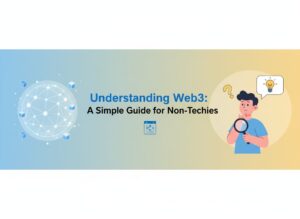
Understanding Web3: A Simple Guide for Non-Techies

Have you ever heard the term “Web3” and wondered what everyone is talking about? You are not alone. It sounds like a buzzword from a sci-fi movie, but it is actually the next big step in the history of the internet.
Some people say it will change everything about how we use the web. Others say it is just a trend. But what is it really? In simple words, Web3 is a new kind of internet where you own your stuff.
In this guide, we will break down the confusing tech words into simple English. We will explain how the internet used to work, how it works now, and what this new “Web3” future looks like.
The Story of the Internet: Web1, Web2, and Web3
To understand Web3, we first need to look at the past. Think of the internet like a video game that has had three major updates.
Web1: The “Read-Only” Internet (1990s – 2004)
Do you remember the early days of the internet? Websites were just pages with text and maybe a few pictures.
- What it was: Like a digital library. You could go to a website and read information, but you couldn’t change anything.
- Your role: You were just a reader. You couldn’t “like” a post or leave a comment.
- Who owned it: The people who built the websites.
Web2: The “Read-Write” Internet (2004 – Present)
This is the internet we use today. It is all about social media, blogs, and apps.
- What it is: A place where everyone can create content. You post photos on Instagram, write tweets on X (formerly Twitter), and upload videos to YouTube.
- Your role: You are a creator and a user. You can interact with everything.
- The problem: Even though you create the content, you don’t own it. Big companies like Facebook (Meta), Google, and Amazon own the platforms. They hold your data, and if they want to ban you or delete your account, they can.
Web3: The “Read-Write-Own” Internet (The Future)
This is the new update people are excited about.
- What it is: An internet where you are not just a user; you are an owner.
- Your role: You can own parts of the internet. If you buy a digital item, it belongs to you, not the game or the website. You can take it with you to other websites.
- Who owns it: The users (that means you!). Instead of one big company controlling everything, the network is shared by everyone who uses it.
The Magic Behind Web3: Key Concepts Explained
Web3 uses some fancy technology to make this ownership possible. Here are the main terms you will hear, explained simply.
1. Blockchain: The Digital Ledger
Imagine a shared Google Sheet that everyone can see, but nobody can delete or cheat.
- A blockchain is just a list of records (like a ledger).
- It records who owns what.
- Once something is written on it, it cannot be erased.
- It is not stored on one computer; it is saved on thousands of computers all over the world at the same time. This makes it incredibly hard to hack.
2. Decentralization: No More “Big Boss”
In Web2, if Facebook’s servers go down, Instagram and WhatsApp stop working for everyone. That is because it is “centralized”—one central place controls it all.
- Web3 is decentralized. This means there is no single boss or main computer.
- It runs on a network of many computers (owned by regular people).
- This makes it harder for anyone to censor you or shut down the network.
3. Cryptocurrency: Internet Money
To make this system work, you need a way to send value without a bank. That is where cryptocurrency comes in.
- Tokens: These are digital coins. You might have heard of Bitcoin (BTC) or Ether (ETH).
- In Web3, tokens are used to pay for services or prove you own something. It is like using arcade tokens to play games, but these tokens have real-world value.
4. NFTs: Digital Ownership Certificates
You have probably heard of people buying expensive pictures of monkeys. Those are NFTs (Non-Fungible Tokens). But NFTs are more than just art.
- An NFT is a digital certificate that says, “I own this unique thing.”
- It could be a digital painting, a ticket to a concert, or a special sword in a video game.
- Because it lives on the blockchain, everyone can see that you are the true owner.
5. Smart Contracts: Robots That Keep Promises
A smart contract is a digital agreement that executes itself automatically.
- Example: Imagine you bet your friend $10 that it will rain tomorrow.
- Old way: You have to trust your friend to pay you if you win.
- Web3 way: You both put your money into a “smart contract.” The program checks the weather report tomorrow. If it rains, it automatically sends the money to you. If it’s sunny, it sends it to your friend. No cheating is possible!
Why Should You Care? The Benefits
Web3 isn’t just for tech geeks. It offers some real benefits for everyday people.
1. You Own Your Data
Right now, companies sell your personal data to advertisers. In Web3, you keep your data in your own digital “wallet.” You can choose to keep it private or sell it yourself. You are in control.
2. Freedom of Speech
Because there is no central “boss,” it is much harder for a platform to ban you just because they don’t like what you said. This is a big deal for people living in countries with strict censorship.
3. One Login for Everything
Do you hate remembering 50 different passwords? In Web3, you use your digital wallet (like a digital ID card) to log in to every website. You connect your wallet, and you are in. No more emails and passwords.
4. Better Payments
Sending money to someone in another country is slow and expensive with banks. With Web3, you can send value instantly to anyone in the world, often with lower fees.
The Risks: What to Watch Out For
Web3 is still very new, and it is not perfect. There are some big risks you need to know before you dive in.
1. No “Forgot Password” Button
This is the scary part of “being your own bank.” If you lose the password (key) to your digital wallet, your money and data are gone forever. There is no customer support to call. You have to be very responsible.
2. Scams and Hacks
Because there is a lot of money involved, there are many scammers. They might try to trick you into clicking a bad link that drains your wallet. You have to be very careful about what you click.
3. It Can Be Expensive
Using some blockchains (like Ethereum) can sometimes cost a fee (called “gas”) to make a transaction. Sometimes these fees are high, making it expensive to do simple things.
4. Environmental Concerns
Some older blockchains use a lot of electricity to run. However, newer technologies are solving this problem and becoming much more eco-friendly.
How to Get Started (Baby Steps)
If you are curious and want to try Web3, you don’t need to spend money. Here is a safe way to dip your toes in.
- Get a Wallet: Download a free Web3 wallet app like MetaMask or Coinbase Wallet. This will be your ID card for the Web3 world.
- Explore Decentralized Apps (dApps): Look for websites that let you “Connect Wallet.” You can try a decentralized social network or a game.
- Learn, Don’t Buy: You do not need to buy expensive crypto to learn. Many places let you explore for free. Read articles, watch videos, and understand the technology first.
Conclusion
Web3 is a big shift from the internet we know today. It moves us from being renters to being owners. It promises a world where you control your data, your money, and your identity.
It is still early days, and the technology can be clunky and confusing. But just like the early internet in the 90s, it is getting better every year. You don’t need to be a computer wizard to understand it—you just need to be curious. Whether it becomes the “new normal” or just a part of the internet, understanding Web3 gives you a glimpse into the future of our digital lives.




Post Comment