Will AI Take Your Job? The Most At-Risk Professions
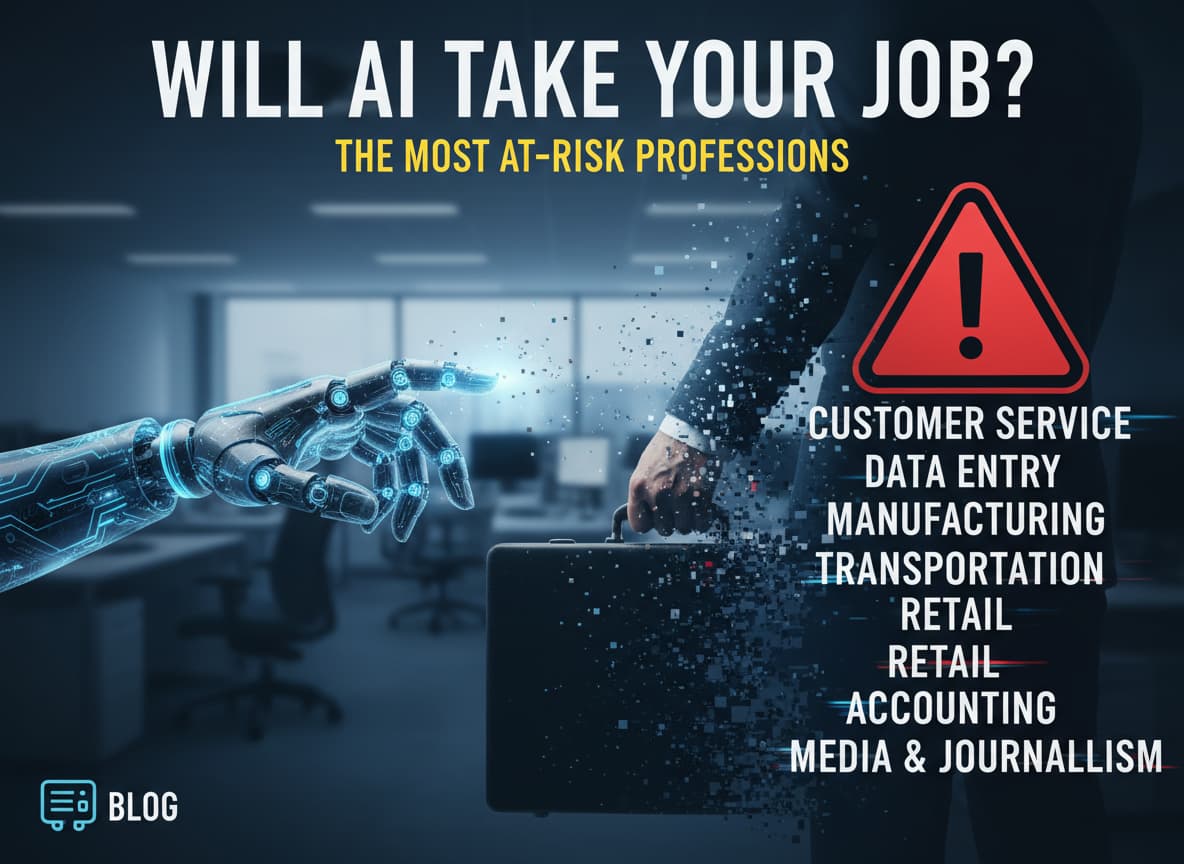
The biggest question on everyone’s mind right now is not about aliens or flying cars. It is about our jobs. We see headlines every day saying that Artificial Intelligence (AI) is getting smarter. It can pass law exams, write poetry, and even create paintings that win awards. This makes many of us nervous. We ask ourselves: “Is my job safe?” “Will a robot replace me?”
These are normal fears. But panic is not the answer. Knowledge is the answer. To survive and thrive in this new world, you need to know exactly what is happening. You need to know which jobs are in the “danger zone,” which ones are safe, and what you can do about it.
In this article, we will look at the real data for 2025 and 2026. We will not use confusing tech words. We will break it down in simple English so you can plan your future with confidence.
The Reality Check: Replacement vs. Change
Before we list the jobs, we need to understand one important thing. In most cases, AI will not walk into your office and fire you. Instead, it will take over tasks.
Think of a job like a pizza. A job is made up of many slices (tasks). AI might eat three slices of your pizza—like sending emails, organizing data, or scheduling meetings. If your job is only those three slices, then yes, your job is in trouble. But if your job has other slices—like creative thinking, solving complex people problems, or using your hands—then AI will likely just be a helper, not a replacement.
However, for some professions, AI is eating the whole pizza. Let’s look at the jobs that are facing the biggest risks right now.
The “Red Zone”: Jobs Facing High Risk
The jobs in this list are mostly “white-collar” jobs. These are jobs where people sit at computers and process information. AI is very, very good at processing information—much faster and cheaper than any human.
1. Data Entry Clerks
This is the number one job at risk. The whole purpose of this job is to take information from one place and type it into another. This is exactly what computers were built to do.
In 2025, businesses are using “Optical Character Recognition” (OCR) and advanced AI. These tools can look at a scanned PDF or a handwritten note and type it into Excel instantly. They do not get tired, they do not make typing mistakes, and they cost almost nothing. If your main daily task is moving data from A to B, it is time to learn a new skill immediately.
2. Customer Service Representatives
We have all spoken to those annoying “chatbots” on websites. In the past, they were stupid. You would say “I have a billing problem,” and they would say “Did you mean ‘reset password’?”
But the new AI is different. It understands context, slang, and emotion. Companies are now using AI agents that can handle 80% to 90% of customer questions without a human ever getting involved. They can process refunds, track packages, and explain complex policies in seconds.
This does not mean all customer service jobs will die. We still need humans for the really angry customers or the very complicated problems that require empathy. But the entry-level jobs answering simple phones and chats are disappearing fast.
3. Telemarketers
Telemarketing is a tough job. It involves calling hundreds of people, reading a script, and trying to sell them something. AI is now taking over this role with scary speed.
AI voices can now sound exactly like humans. They can pause, say “um,” and laugh naturally. A computer can make 10,000 calls in an hour, while a human can maybe make 20. For companies, the math is simple. AI is cheaper and more efficient. If your job relies on reading a sales script over the phone, you are in a high-risk category.
4. Translators and Interpreters
Language is complex, and for a long time, we thought only humans could translate it well. But tools like Google Translate and ChatGPT have become incredibly powerful.
For basic business documents, manuals, and standard text, AI is now “good enough” for most companies. It is practically free and instant. High-level translators who work on literature, legal contracts, or sensitive diplomatic meetings are still safe because nuance is key. But for general translation work, the market is shrinking rapidly.
5. Junior Graphic Designers and Copywriters
This is a controversial one. Creativity was supposed to be the human “superpower.” But Generative AI (like Midjourney for images and Claude for text) has changed the game.
- Writers: AI can write SEO articles, social media captions, and basic emails in seconds. “Content mills” that used to pay humans pennies to write generic articles are now switching to AI.
- Designers: Small businesses used to hire junior designers to make logos or flyers. Now, they can type “logo for a coffee shop, green and brown” into an AI tool and get 50 options in one minute.
The jobs at risk here are the “execution” roles—the people who just make the thing. The “strategy” roles—the people who decide why we are making it and who it is for—are still safe.
The “Yellow Zone”: Jobs That Will Change Completely
These jobs are not going away, but they will look very different in five years. If you work in these fields, you don’t need to quit, but you do need to adapt.
1. Computer Programmers and Coders
You might be surprised to see this here. Wasn’t coding supposed to be the future? It still is, but the work is changing.
AI tools like GitHub Copilot can now write big chunks of computer code on their own. They can find bugs and fix errors faster than a human. This means we will need fewer “junior” coders who just write basic lines of code.
However, we will need more senior engineers who understand how to design complex systems. The job is shifting from “writing code” to “supervising AI that writes code.” It is becoming more about architecture and logic than just typing syntax.
2. Accountants and Bookkeepers
Math is easy for computers. AI can scan receipts, categorize expenses, and even prepare tax returns. The days of an accountant sitting with a calculator and a stack of paper are over.
But businesses still need advice. They need someone to say, “Hey, based on these numbers, you should invest in a new factory.” The “number crunching” is going to AI, but the “financial strategy” is staying with humans.
3. Teachers and Educators
AI cannot replace the connection between a student and a teacher. A robot cannot inspire a child or comfort them when they fail a test.
However, AI will take over the boring stuff. It will grade essays, create lesson plans, and even provide personalized tutoring for students who are falling behind. Teachers will become more like “mentors” and “coaches,” guiding students through their emotional and social growth, while AI handles the raw information delivery.
The “Green Zone”: The Safe Havens
If you want a job that is almost “robot-proof,” look for three things:
- Complex Physical Work: Things that require moving around in unpredictable environments.
- Deep Emotional Connection: Jobs that require genuine empathy and human trust.
- High-Level Strategy: Jobs that require making big, messy decisions with no clear right answer.
1. Skilled Trades (The Hands-On Heroes)
Electricians, plumbers, carpenters, and mechanics are very safe. Why? Because every house is different. A toilet in an old building is different from a toilet in a new one. A robot cannot easily climb into a cramped crawlspace, diagnose a weird leak, and fix it with a wrench.
Robots are good at doing the exact same motion over and over (like in a car factory). They are bad at dealing with the messy, chaotic real world. These jobs are not only safe; they are also in high demand.
2. Healthcare Professionals
Doctors, nurses, and therapists are largely safe. AI is actually helping them—for example, AI is better at spotting cancer in X-rays than human eyes.
But would you want a robot to tell you that you have a serious illness? Would you want a robot to hold your hand before surgery? The human touch is a critical part of healing. Jobs that involve care, physical therapy, and mental health support rely on human connection that machines cannot fake.
3. Creative Directors and Strategists
While AI can write a sentence or draw a picture, it doesn’t have “taste.” It doesn’t know what is cool, what is culturally sensitive, or what will make people laugh.
Senior creative roles—the people who come up with the big ideas and direct the vision—are safe. They will use AI as a tool to work faster, but the “spark” of the idea must come from a human mind.
Why is 2025 the Tipping Point?
You might be thinking, “People have been saying robots will take our jobs for 50 years.” That is true. But this time is different.
In the past, automation only took “blue-collar” jobs (physical work). Now, it is coming for “white-collar” jobs (brain work). The speed is also different. Technologies like ChatGPT are improving not every ten years, but every few months.
We are entering the era of “Agentic AI.” This means AI doesn’t just answer questions; it does things. It can plan a trip, book the flights, and pay for the hotel. This shift from “chatting” to “doing” is what puts administrative and support roles at such high risk right now.
How to “Robot-Proof” Your Career
So, what should you do? Do not despair. History shows that technology creates new jobs even as it destroys old ones. Here is your survival guide.
1. Develop Your “Soft Skills”
Computers are smart, but they have zero emotional intelligence (EQ). They cannot negotiate a difficult deal, resolve a conflict between two employees, or lead a team through a crisis. Skills like leadership, empathy, communication, and negotiation are becoming more valuable than technical skills.
2. Become “AI-Literate”
Do not hide from AI. Learn it. If you are a writer, learn how to use AI to generate ideas. If you are an accountant, learn which AI tools can automate your data entry so you can focus on strategy.
The person who gets hired in the future will not be the one who competes against AI. It will be the one who knows how to work with AI. You want to be the pilot, not the passenger.
3. Focus on Complex Problem Solving
AI is great at following rules. It is bad at breaking them or thinking outside the box. If your job involves following a strict manual every day, you are at risk. If your job involves looking at a messy, new problem and figuring out a creative solution, you are safe.
Conclusion: The Future is Human
The headlines are scary, but the future is not written yet. Yes, AI will disrupt the workforce. Estimates say up to 300 million jobs could be affected globally. But this transition also offers a chance to get rid of the boring, repetitive parts of our work.
Imagine a world where doctors spend more time talking to patients and less time typing notes. Imagine a world where teachers spend more time mentoring students and less time grading papers.
The goal is not to be better than the robot. The goal is to be more human. By focusing on the things that only people can do—caring, creating, and connecting—you can build a career that no machine can touch.









Post Comment